Basic Philosophy for Corporate Governance
Our basic approach to corporate governance is rooted in our corporate mission: “We contribute to the health of society through our diligent efforts to create healthcare solutions that have a positive impact and improve the lives of people.” To put this philosophy into practice, we strive to build a governance framework that enables the management team to efficiently oversee compliance with laws, our Articles of Incorporation, and internal policies and regulations. PHC Group is committed to building and implementing appropriate governance, with a view to ensuring management soundness, efficiency, and transparency, and to continuously enhancing corporate value.
PHC Group Governance Structure
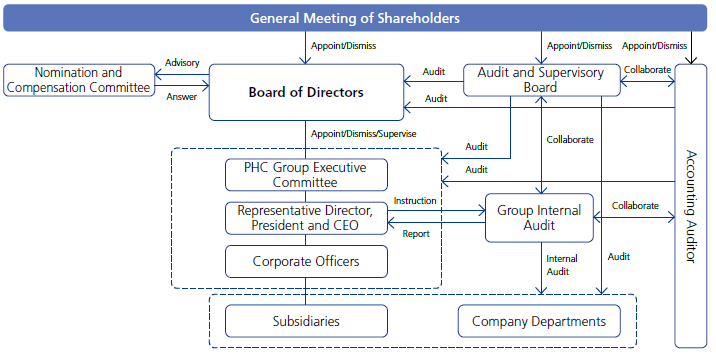
Board of Directors
The Board of Directors is composed of eight directors, including five external directors. When appointing external directors and external auditors, we apply a skills matrix to ensure a balance of knowledge, experience, abilities, and perspectives among the candidates, and to enhance objectivity and transparency of our appointment policies and procedures. Our Nomination and Compensation Committee deliberates on any selection or dismissal involving management, taking into consideration the business environment and nature of our operations. The results are submitted to the Board of Directors, which then deliberates and makes the final resolution. Furthermore, the three independent external directors have management experience in other companies and organizations, and bring the necessary qualifications to contribute to our sustainable growth and corporate value improvement over the medium to long term.
Activities of the Board of Directors
A total of 16 meetings were held during fiscal year 2025, and the main deliberations and reports were as follows:
| Discussions and report content |
Details |
| Matters related to Group performance |
Monthly performance reports, approval of quarterly and annual financial results, etc. |
| Matters related to business plans
| Approval of business plans for the next fiscal year. Assessment of U.S. tariff potential impacts on business plans |
| Matters related to financial activities
| Group cash management, short- and long-term financing, the holding status of cross-shareholdings, etc. |
| Matters related to business strategies
| Discussion concerning strengthening of business foundations, growth strategies, etc. in the Diagnostics & Life Sciences domain |
| Matters related to the business portfolio
| Discussion related to transfer of the Eversense® continuous glucose monitoring (CGM) system business, business portfolio management, etc. |
| Matters related to appointment and compensation of directors and executives
| Appointment of directors, CxOs, executives, domain heads, and others, setting target values for short-term performance-linked compensation, granting of post-delivery stock compensation, etc. |
| Matters related to employee engagement
| Analysis of employee engagement survey results, granting of post-delivery stock compensation, etc. |
| Matters related to key risks
| Analysis of any key risks and consideration of countermeasures |
| Matters related to compliance, litigation, or disputes
| Status reports on any pending compliance matters, litigation, or disputes within the Group |
| Matters related to sustainability
| Reports on Group ESG initiatives and their results, establishment of a human rights policy and net-zero target for greenhouse gas emissions, and implementation of training by outside experts |
| Matters related to audits
| Reporting on audit policies, plans, and results by the Audit and Supervisory Board and the Internal Audit Department |
| Matters related to the effectiveness of the Board of Directors
| Evaluation of the effectiveness of the Board of Directors, examination of issues and responses based on the evaluation results |
Details of Deliberation on Individual Agenda Items: Transfer of the Eversense® Continuous Glucose Monitoring (CGM) System Commercial Business
In fiscal year 2025, the company adopted a resolution to transfer the Eversense® continuous glucose monitoring (CGM) system commercial business from Ascensia Diabetes Care Holdings AG, a consolidated subsidiary, to Senseonics Holdings, Inc., the manufacturer of Eversense®. PHC Group, Ascensia, and Senseonics agreed that unifying development, manufacturing, and distribution within Senseonics would enable Eversense® to accelerate growth and realize its full potential faster than under the previous structure. For PHC Group, this decision also aligned with the portfolio management component of our Value Creation Plan 2027. The transfer was carefully discussed in meetings of the Board of Directors and through exchanges of opinions outside the Board. During the process, the external officers raised numerous questions and opinions, leading to a lively discussion.
- Main Opinions Expressed by External Officers
-
- Although we have continued to invest in this business given its strong growth potential, we should consider reassessing the assumption that we will continue the business in light of the current competitive environment.
- Given the Company’s cash flow situation, the investment required for this business is substantial, and there may be a gap between this investment and the types of investments our shareholders expect us to make.
- As the business transfer will take place across multiple countries, are there any constraints under labor laws that need to be considered?
There was also active discussion of other matters, including temporary income and costs associated with the transfer, its expected impact on business performance, the structure and terms of the agreements, and potential risks.
Criteria and Qualities for Evaluating the Independence of Independent External Directors
When appointing external directors and external auditors, PHC Group determines independence based on standards set by the Tokyo Stock Exchange. We appoint individuals who are capable of making appropriate contributions to our management from an objective perspective, based on their extensive knowledge and experience. When appointing external directors and external auditors, the Nomination and Compensation Committee considers compatibility with independence standards and policies, and escalates the results to the Board of Directors, which deliberates upon those results and makes a decision.
Support System for External Directors (External Auditors)
To ensure that the Board of Directors can engage in thorough discussions, the executive team provides support to external directors and external auditors, such as advance briefings and information prior to Board of Directors meetings. The Audit and Supervisory Board and by the Auditing Office, which is comprised of full-time staff and functions as the secretariat for the Audit and Supervisory Board, also provides information and other support to external auditors.
Audit and Supervisory Board
The Audit and Supervisory Board is composed of three members, including two external auditors. In addition to regular meetings, the Audit and Supervisory Board holds extraordinary meetings as necessary to discuss governance practices and the status of daily business operations and assets.
When deemed necessary, the members of the Audit and Supervisory Board arrange opportunities to interview directors or employees of PHC Holdings Corporation and PHC Group. In addition, they hold regular meetings to collaborate with accounting auditors and the corporate auditors of key subsidiaries, and attend important meetings.
Number of Audit and Supervisory Board meetings held:
13
The Audit and Supervisory Board creates opportunities to share information with the Internal Audit Department on a monthly basis, mutually confirming the details of audits and exchanging opinions. In addition, the Audit and Supervisory Board has established a system for providing regular updates and sharing opinions regarding audit plans, reports, and implementation with the accounting auditor. This system enables sharing of information on key matters related to internal controls, as identified through audits by Audit and Supervisory Board members as well as internal audits.
Nomination and Compensation Committee
To support the Board of Directors, PHC Group has established a voluntary Nomination and Compensation Committee, whose main members are independent external directors. The Nomination and Compensation Committee deliberates and makes recommendations on matters related to the appointment and dismissal of directors, succession plans for representative directors and executive officers, and matters related to compensation of directors and executive officers to be submitted to the Annual General Meeting of Shareholders. Regarding the position of Representative Director and President (CEO), the Nomination and Compensation Committee is responsible for selecting a person who demonstrates leadership in realizing the company’s management philosophy and achieving sustainable growth. The Nomination and Compensation Committee consists of four members: two independent external directors, one external director, and the Representative Director.
Activities of the Nomination and Compensation Committee
| Meeting |
Discussions and report content |
| 1st Meeting |
Agenda items to be submitted to the Annual General Meeting of Shareholders in 2025 regarding nomination and compensation |
| 2nd Meeting |
Individual performance evaluation of officers, amounts of short-term performance-linked compensation |
| 3rd Meeting |
Performance of officers, individual target setting |
| 4th Meeting |
Succession plan for officers |
| 5th Meeting |
Interim evaluation of officers, policy for determining individual compensation for officers |
| 6th Meeting |
Compensation of officers |
| 7th Meeting |
Appointment and compensation of officers |
Fiscal year 2025
7meetings held
PHC Group Executive Committee
We established the PHC Group Executive Committee for the purpose of streamlining management-related decision-making and clarifying decision-making procedures. Meetings of the committee are held monthly. The PHC Group Executive Committee is an executive meeting body that decides important matters related to the management of PHC Group (including all subsidiaries) and manages the objectives and progress of plans for the entire Group.
The current composition of the Executive Committee is listed below.
Members: Kyoko Deguchi (Chairperson/CEO), Koichiro Sato (Chief Operating Officer, Chief Strategy Officer),
Kaiju Yamaguchi (Chief Financial Officer), Ryuichi Hirashima (Chief Administrative Officer, Chief Human Resources Officer, Chief Technology Officer), Takahide Watanabe (Observer/Corporate Officer), Toru Yoshimitsu (Observer/Full-time Audit and Supervisory Board Member)
Appointment of Officers, Board Members (Including Audit and Supervisory)
When appointing directors and Audit and Supervisory Board members, we carefully consider candidates’ expertise, experience, abilities, and diversity of perspectives. To ensure objectivity and transparency in the selection process, we utilize a proprietary skills matrix.
For the appointment of external directors and External Audit and Supervisory Board members, our basic policy is to assess the skills and expertise of our existing Directors, Audit and Supervisory Board Members, and Corporate Officers, and then select individuals who possess the skills and experience to supplement the company’s needs. Additionally, we confirm candidates’ independence based on the Tokyo Stock Exchange’s independence criteria and select individuals with extensive knowledge and experience who can contribute objectively to our company management.
When appointing directors, the appointment is reviewed by the Nomination and Compensation Committee, approved by the Board of Directors, and then submitted to the Annual General Meeting of Shareholders as a proposal for resolution. When appointing Audit and Supervisory Board members, the consent of the Audit and Supervisory Board is obtained first, and the matter is then submitted to the Annual General Meeting of Shareholders as a proposal for resolution.
Status of Internal Audits
PHC Group has established our Group Internal Audit Department as an organization under the direct control of the CEO. A total of 13 members, including the Group Internal Audit Manager, conduct operational and internal control audits of PHC Holdings Corporation and its subsidiaries. Audit results are reported in a written report by the Group Internal Audit Department Manager to the CEO, and related officers.
The Group Internal Audit Department Manager reports monthly to the CEO on the internal audit activities status. The Manager also reports on a monthly basis to the company’s auditors about the status of audits and exchanges information and opinions with the auditors. Other directors and auditors receive internal audit reports through the Board of Directors and the Audit and Supervisory Board, and share their opinions to improve the usefulness of the audit. In addition, the Group Internal Audit Department maintains appropriate links with auditors, directors, and outside auditors of subsidiaries and affiliates as necessary, and strives to carry out efficient internal auditing.
Regarding Executive Compensation
Compensation for directors is determined by the following basic policy:
- Compensation should contribute to securing and retaining excellent global talent who can lead the realization of PHC Group’s vision.
- Compensation takes into account the link between Group performance and individual performance.
- Compensation is linked to the sustainable enhancement of PHC Group’s corporate value to align interests with shareholders.
- Transparency and objectivity are ensured.
Compensation Standards Policy
To secure and retain excellent talent, compensation for directors is set at competitive and appropriate levels commensurate with their role and responsibilities at a global healthcare company. Specifically, we set benchmarks based on compensation levels in the countries and regions that are our main recruiting markets using compensation data from external research organizations and determine compensation in each fiscal period through relative comparison.
Specifically, the compensation amounts for individual directors are determined by the CEO pursuant to authority delegated by the Board of Directors. The CEO determines individual compensation amounts based on an overview of the Company’s overall management situation and evaluations of each director’s duties. To ensure objectivity and transparency in the determination process, the compensation amounts of each individual are deliberated on by the voluntary Nomination and Compensation Committee. Based on the recommendations of the committee, the CEO finalizes the specific compensation amounts of each director in accordance with the policy for determining individual compensation amounts established by the Board of Directors.
Compensation Structure
Compensation for Directors (excluding external directors)
Compensation for directors (excluding external directors) consists of fixed monthly compensation, short-term performance-linked compensation as variable compensation, stock compensation, and retirement benefits. Regarding stock compensation, the company adopts a performance share unit (PSU) plan and a restricted stock unit (RSU) plan, both of which are post-delivery type arrangements.
| Structure |
Outline |
| Monthly Compensation |
Regular monthly compensation commensurate with roles and responsibilities |
| Short-Term Performance-Linked Compensation |
Short-term incentives for achieving business performance goals over the year |
| Performance Indicators and Weights for Short-Term Performance-Linked Compensation in Fiscal Year 2026 |
Return on Invested Capital (ROIC) |
25.0% |
| Operating Profit |
25.0% |
| Net Profit |
25.0% |
| Individual Performance Goals |
25.0% |
| Stock Compensation |
Medium- to long-term incentives designed to enhance value sharing between directors and shareholders |
| Retirement Benefits |
In accordance with the stipulations in the Rules for Directors and Corporate Auditors |
Compensation for Audit and Supervisory Board Members (Excluding External Auditors)
Compensation for auditors comprises monthly compensation and retirement benefits pursuant to discussions and a decision by the Audit and Supervisory Board.
Compensation for External Directors
Compensation for independent external directors is based on monthly compensation and stock compensation. Note that independent external directors are the only external directors to receive compensation.
Regarding stock-based compensation, we introduced a post-delivery restricted stock unit (RSU) plan with the aim of further expanding our global business and achieving growth goals. The objective is to further increase incentives for share price appreciation and corporate value enhancement while also securing top talent.
Compensation for External Auditors
Compensation for external auditors is determined based on discussions and a decision by the Audit and Supervisory Board and consists of monthly compensation only.
- Total Amount of Compensation, etc., by Officer Classification (Actual for the fiscal year ended March 31, 2026)
-
| Officer classification |
Total amount of compensation, etc. (million JPY) |
Total amount of compensation by type (million JPY) |
Number of eligible officers (persons) |
| Fixed compensation |
Stock options*1 |
Performance-linked compensation*2 |
Retirement benefits |
Others |
Of the columns listed on the left, non-monetary compensation, etc. |
| Directors (excluding external directors) |
404 |
145 |
- |
104 |
41 |
113 |
113*3 |
3 |
| Audit and Supervisory Board Members (Excluding External Auditors) |
24 |
21 |
- |
- |
2 |
- |
- |
2*5 |
| External directors |
112 |
60 |
1 |
- |
- |
50 |
52*4 |
3*6 |
| External auditors |
25 |
25 |
- |
- |
- |
- |
- |
3*5 |
- *1The amounts stated for stock options are the calculated values as of the end of March 2026 for options granted in or before the fiscal year under review.
- *2The targets and results of indicators related to performance-linked compensation for the current consolidated fiscal year are as follows. Each index was reviewed by the Nomination and Compensation Committee and approved by the Board of Directors, taking into consideration the balance and comprehensiveness of the company’s business growth potential, profitability, and efficiency. The operating profit below is the adjusted operating profit excluding one-time expenses. Also, the table below shows the actual results for the fiscal year ended March 2025, which were applied to compensation for the fiscal year ended March 2026.
| Evaluation index |
Weight |
Target for the fiscal year ended March 2025 |
Achievements |
Level of achievement |
| Core sales |
26.0% |
360,047 million JPY |
348,572 million JPY |
97% |
| Operating profit |
30.0% |
20,378 million JPY |
22,232 million JPY |
110% |
| Net profit |
19.0% |
10,278 million JPY |
10,485 million JPY |
103% |
| Individual targets |
25.0% |
Set for each person |
Set for each person |
Set for each person |
- *3Non-monetary compensation, etc. is the amount of long-term incentives to be recorded as expenses for the current fiscal year. The amount of non-monetary compensation, etc. for directors (excluding external directors) includes stock options, post-delivery performance share units (PSUs), and post-delivery restricted stock units (RSUs). The compensation limits for stock-based compensation for directors (excluding external directors) were set by resolution at the Annual General Meeting of Shareholders held on June 25, 2025 as described below (number of directors excluding external directors at the time of the resolution: 3).
・Post-delivery performance share units (PSUs): Up to 229,000 shares per year and up to 573 million JPY per year
・Post-delivery restricted stock units (RSUs): Up to 187,000 shares per year and up to 468 million JPY per year for directors as a whole, including independent external directors
- *4The amount of non-monetary compensation, etc. for external directors includes stock options and post-delivery restricted stock units (RSUs). The compensation limit for stock options for independent external directors is up to 70 million JPY per year (resolved at the Annual General Meeting of Shareholders held on June 29, 2022; number of directors at the time of the resolution: 3). The compensation limits for post-delivery restricted stock units (RSUs) for independent external directors are up to 72,000 shares per year and up to 180 million JPY per year (resolved at the Annual General Meeting of Shareholders held on June 25, 2025; number of independent external directors at the time of the resolution: 3).
- *5The number of Audit and Supervisory Board members indicated includes auditors who retired during the fiscal year.
- *6The number of external directors indicated excludes two uncompensated external directors.
Evaluation of the Effectiveness of the Board of Directors
In January and February 2026, PHC Group conducted a questionnaire and individual interviews regarding the effectiveness of the Board of Directors as a whole, targeting all directors (eight directors) and members of the Audit and Supervisory Board (three members) at the time. The questionnaire and interviews covered the topics listed below.
- (1) Composition of the Board of Directors
- (2) Matters related to the operation of the Board of Directors
- (3) Effectiveness of the Board of Directors as a whole
- (4) System related to support and cooperation with external directors
- (5) Audit function
- (6) Nomination and Compensation Committee
- (7) Relationship with shareholders and investors
- (8) Protection of minority shareholders
- (9) Others (Status of responses to issues pointed out in the previous effectiveness evaluation, etc.)
To ensure objectivity, we received support from a third-party organization regarding the design of the questionnaire content, the implementation of individual interviews, and analysis and assessment of the evaluation results.
Based on the results of the analysis by the third-party organization, the Board of Directors assessed the current situation and issues.
Evaluation Results
We believe that our Board of Directors is functioning appropriately and effectively. Regarding the issues of “monitoring the status of ESG initiatives” and “discussion of key sustainability issues,” which were identified as the main issues in the previous effectiveness evaluation, significant improvement was observed as a result of conducting training on human rights led by external experts, sharing progress on ESG and sustainability initiatives, and holding discussions on related topics. Improvement was also observed regarding “clear sharing of concerns based on audits with the Board of Directors.”
Comments From Individual Officers in the Effectiveness Evaluation
Some of the comments made by individual officers in the evaluation of the effectiveness of the Board of Directors are presented here. Based on these inputs, we are continuously working to improve our governance and the functioning of the Board.
- I believe that effectiveness overall is achieved through discussions of business plans, Value Creation Plan, and individual investment matters. At the same time, amid the TSE’s capital market reforms, I believe that we need to continue strengthening our efforts in areas of growing importance, including being conscious of the cost of capital, ESG initiatives, and coordination of shareholder relations with institutional investors.
- Responding to immediate issues takes time, and more time should be allocated to the Company’s management from a comprehensive and long-term perspective.
- Based on current regulations, I believe that the frequency of Board of Directors meetings and the criteria for selecting agenda items are appropriate, but there is also the view that the division of responsibilities between the Board and the executive side should be reviewed, with more authority delegated to the executive side. Specifically, I believe that this should include matters such as reviewing monetary thresholds for referral to the Board and renewal of business-related contracts.
- The timing of the advanced distribution of materials to the Board has improved somewhat compared to the previous fiscal year, but further improvement is still needed.
- The transfer of the CGM business was thoroughly discussed, and this decision is an example of appropriate follow-up being carried out after investment implementation.
Officer Training Policy
The company provides a range of training opportunities not only for directors and members of the Audit and Supervisory Board, but also for all employees to acquire the skills and knowledge necessary for their work. When new external directors and members of the Audit and Supervisory Board are appointed, in addition to their legal roles and responsibilities, the company provides information necessary for those officers to contribute to effective supervision of the company’s management (for example, industry information, company history, business overview, financial information, strategy, and organization). In addition, to support deliberations of the Board of Directors, we provide opportunities to acquire and update the knowledge necessary for management supervision. The company also bears the cost of seminars, networking events, and the like in which officers voluntarily participate based on their individual needs.
Cross-Shareholdings
In principle, the company has a policy of not holding cross-shareholdings. However, if cross-shareholdings are held from the perspective of business strategy, the significance of the holdings must be confirmed by the Board of Directors at the time of acquisition. In addition, the Finance Department regularly conducts an inventory to determine the significance of cross-shareholdings, and if it is determined that holding the shares is not meaningful, the company will consider selling the stock. The results of the consideration of sales are reported to the Board of Directors each year. Regarding the exercise of voting rights in relation to cross-shareholdings, we do not set uniform standards, but rather respect the management policies and strategies of investee companies and exercise voting rights after making a comprehensive judgment as to whether doing so will contribute to improving our corporate value over the medium to long term.
Policy Regarding Constructive Dialogue With Shareholders
To build trusting relationships with our shareholders and other stakeholders, we believe that it is essential to understand stakeholder expectations and reflect them appropriately in management practices. We seek to respond to IR/SR activities proactively.
- (ⅰ) The CFO serves as senior executive corporate officer in charge of IR and oversees the Group’s IR activities. In addition, the Investor Relations & Corporate Communications Department, which proactively handles IR-related meetings such as individual interviews with institutional investors and analysts, was established under the CFO. Financial results briefing sessions are held online so that anyone can participate, with explanations given primarily by the CEO, COO, and CFO. Meetings with shareholders are conducted by the CFO with support from the Investor Relations & Corporate Communications Department. The CEO and other officers also respond as necessary.
- (ⅱ) As a support system for shareholder dialogue, the IR & Corporate Communications Department collaborates with each business department and management department on a regular basis.
- (ⅲ) In addition to holding financial results briefing sessions and business briefing sessions, the company participates in domestic and international conferences run by securities companies and others, and holds small meetings with investors.
- (ⅳ) The CFO periodically reports feedback acquired through IR/SR activities to the Board of Directors.
- (ⅴ) When engaging in dialogue with investors, whether at financial results briefings, individual meetings, or small meetings, we closely manage undisclosed material facts and comply with fair disclosure rules.
- Fiscal Year 2025 Dialogue Results
-
| Financial results briefings*1 |
4 (quarterly) |
| Individual meetings with institutional investors and analysts |
123 |
| Business briefings for institutional investors and analysts |
1 |
- *1Financial results briefings are held using an online conference format and are available to anyone to view. English-language materials are also displayed and simultaneous interpretation is conducted. Videos of briefings are made publicly available at a later date, and the Q&A sessions are also published in written form.
Employee Stock Purchase Program
PHC Group offers an Employee Stock Purchase Program for eligible employees in 14 countries, including Japan. Due to regulations in various countries, it can be challenging for individuals outside Japan to invest in companies listed on the Tokyo Stock Exchange, so this plan provides eligible employees an opportunity to become shareholders in PHC Holdings Corporation. The purpose of the plan is to create a culture of shared ownership in the company’s business management, to create demand for the company’s shares, to improve liquidity in the stock market, and to enhance employee benefits by providing incentive payments for participation.